If you love your husband, but your body still braces. This isn’t a communication problem. It’s a capacity problem.
You don’t need to try harder.
You need a nervous system that can stay. Returning to Love is a 4-month, structured nervous system capacity intervention for women in committed relationships who want intimacy to feel steady again.

If you love your husband, but your body still braces. This isn’t a communication problem. It’s a capacity problem.
You don’t need to try harder.
You need a nervous system that can stay. Returning to Love is a 4-month, structured nervous system capacity intervention for women in committed relationships who want intimacy to feel steady again.
You are partnered with someone you care about and yet closeness still requires effort.
Something in you tightens.
Not dramatically.
Not consciously.
Just enough to keep you slightly outside the moment.
Your partner reaches for you and your body pulls back before you’ve had a thought.
Conversation drifts, not from disinterest, but from effort.
Touch feels like something to regulate instead of rest into.
You stay kind.
Capable.
Present.
And quietly… you stay braced.
This isn’t a failure of love.
And it isn’t a lack of desire.
It’s a nervous system pattern.
At some point, often long before this relationship, your body learned that closeness required protection.
So it adapted.
It learned to stay composed.
Stay capable.
Stay slightly removed, just in case.
Those responses were intelligent once.
They helped you succeed.
They helped you stay intact.
But now, they’re limiting your access to intimacy.
The details of how it formed differ.
The protection is the same.
Your body learned that closeness required containment.
So it stayed slightly outside the moment.
What Returning to Love Does
Returning to Love does not teach communication techniques.
It does not increase insight.
It does not excavate your history.
It increases your nervous system’s capacity to remain present while connected.
When capacity increases:
• Touch stops triggering subtle withdrawal
• Conflict no longer collapses you into shutdown or over-functioning
• Desire becomes available instead of managed
• Closeness stops costing you energy
Returning to Love runs as a structured, start-and-finish 4-month cohort.
Each month builds on the previous one.
This is not a drop-in program.
It is a progressive capacity-building process.
Month 1: Mapping Protection
In the first month, you identify exactly how your protection pattern operates in real time.
You learn to recognize the moment your body begins to brace, often before it fully activates. Instead of personalizing your reactions, you begin understanding them neurologically.
By the end of Month 1, you can see the pattern while it’s happening, not only after it’s over.
Month 2: Expanding Capacity
In Month 2, we begin expanding your window of tolerance inside connection.
You practice staying present during moments that previously felt overwhelming.
Recovery shortens.
Activation becomes more manageable.
You return to yourself more quickly.
Closeness starts to feel less destabilizing.
Month 3: Interrupting Automatic Reactivity
By Month 3, the automatic loops begin loosening.
You pause under relational pressure instead of collapsing into shutdown or over-functioning.
Repair becomes steadier.
Conflict feels workable instead of threatening.
Your nervous system starts trusting that it can remain present.
Month 4: Rebuilding Intimacy Capacity
With more stability in place, we expand into intimacy directly.
You practice receiving without losing autonomy.
Staying present during touch.
Allowing desire without performance.
By the final month, intimacy no longer feels like something you brace for.
It feels accessible.

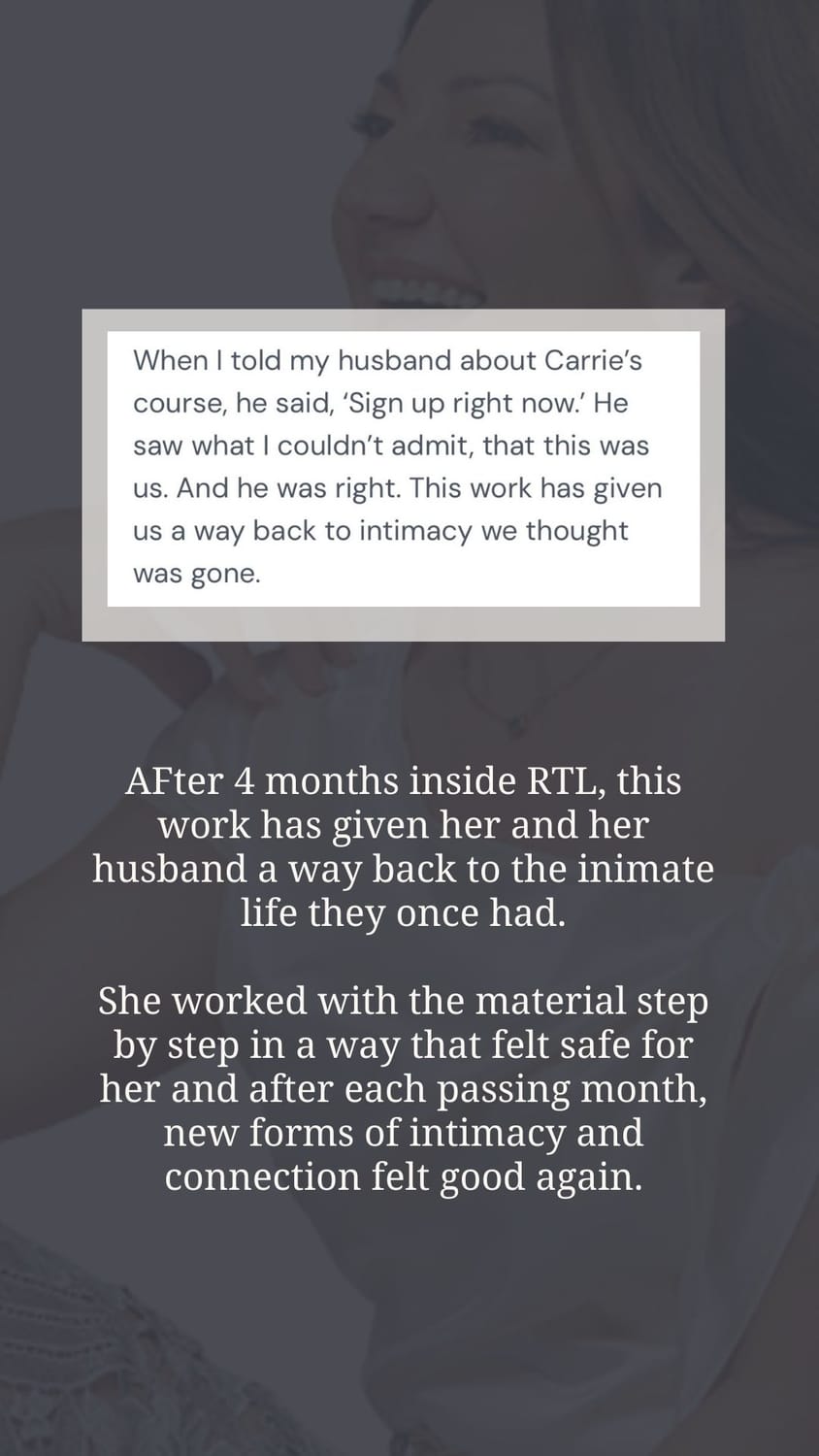
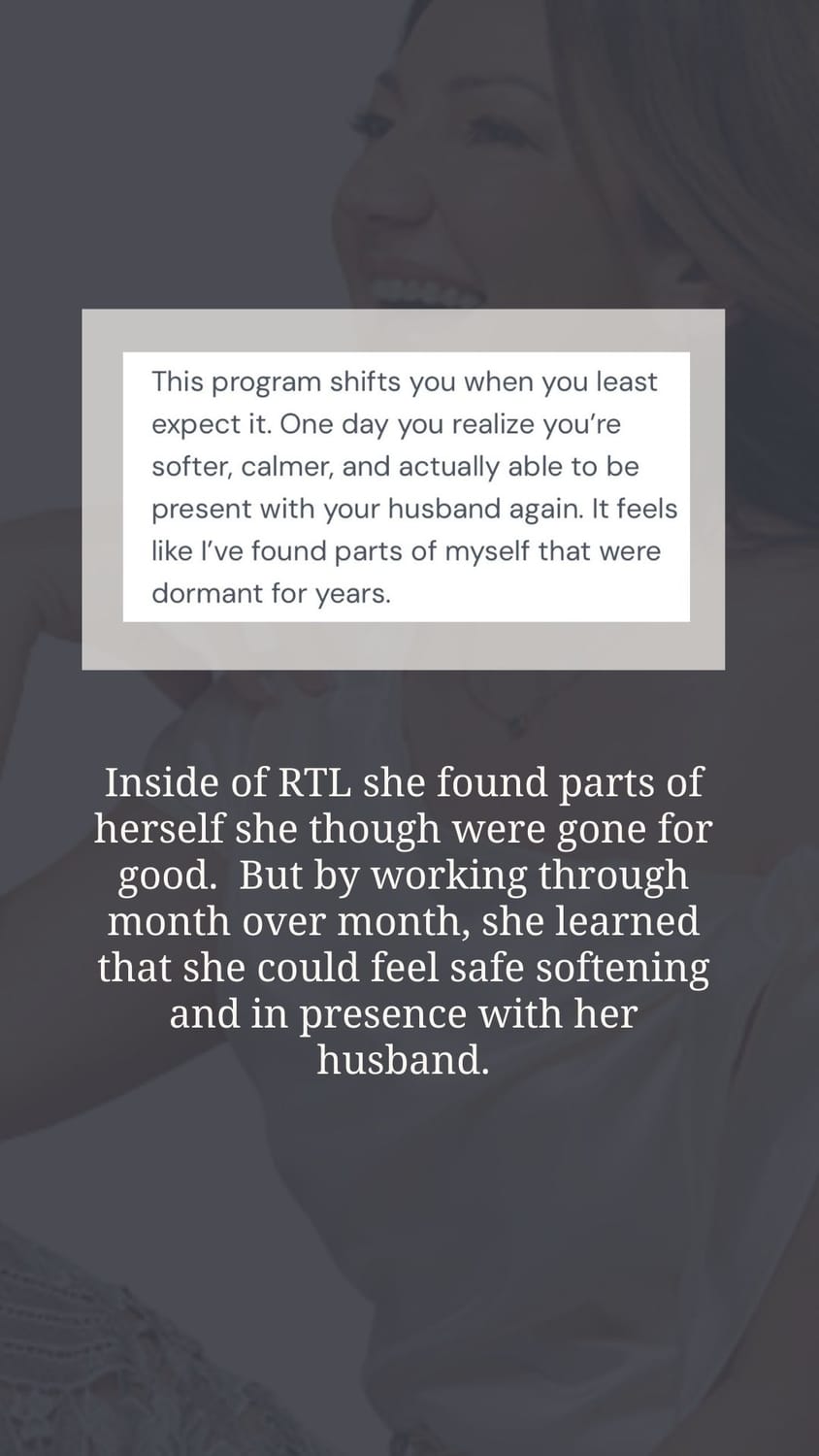
What Women Experience Inside RTL



What This Looks Like in Real Moments
Most women begin noticing the first shifts within the first month.
Shutdown shortens.
Recovery becomes faster.
Reactivity becomes more visible before it takes over.
By the final month, intimacy no longer feels like something to brace for.
Nothing dramatic changes on the outside.
You’re still capable.
Still busy.
Still holding a lot.
What changes is internal.
Your partner reaches for you in the kitchen.
And instead of tightening, your body stays.
You don’t have to prepare.
You don’t have to manage your reaction.
You’re simply there.
A hard conversation begins.
Your heart rate rises, but you don’t disappear.
You stay present long enough to respond instead of react.
You don’t need hours alone to recover from connection.
You don’t feel resentful after intimacy.
Touch feels neutral, sometimes even welcome, instead of something you brace through.
Desire doesn’t have to be manufactured.
It becomes available when the conditions are right.
Not because you forced it.
Because your nervous system stopped blocking it.
Connection no longer feels like something that costs you energy.
It becomes something that restores it.

Why insight hasn't changed this
You may already understand your patterns.
You might know your attachment style.
You may have done meaningful therapy.
You may communicate thoughtfully and with care.
And yet, when closeness actually appears, when your partner reaches for you, when a conversation turns emotionally charged, your body still tightens.
That isn’t a lack of effort.
And it isn’t resistance.
It’s protection.
Insight helps you understand your history.
It does not automatically retrain a protection response.
Protection lives in the nervous system.
And when the nervous system perceives intimacy as even slightly unsafe: too exposing, too intense, too unpredictable, it will default to what it learned.
By bracing, managing and pulling back.
Not because you don’t want connection.
Because your body once decided that staying contained was the safest way to stay intact.
Until your nervous system experiences closeness differently, not just understands it differently, it will continue to respond the same way.
Returning to Love works at that level.
Not by analyzing the pattern further.
But by increasing your capacity to remain present inside it.
That shift doesn’t happen through more discussion.
It happens through structured, repeated experiences of staying present while connected. That is the work inside Returning to Love.
RETURNING TO LOVE
Returning to Love is a 4-month, live, cohort-based nervous system capacity program for women in committed relationships who want intimacy to feel steady again.
We begin together.
We move through a structured progression.
We complete the work together.
This is not open-ended support.
It is a contained, clinically guided process designed to increase your capacity to remain present during:
• Touch
• Conflict
• Emotional vulnerability
• Sexual intimacy
• Everyday connection
Each month builds on the last.
Nothing is random.
Nothing is rushed.
The goal is not more insight.
The goal is internal steadiness that holds in real moments.
Who Returning to Love Is For
Returning to Love is for women who:
• Are currently in a committed relationship or marriage
• Love their partner and want the relationship to work
• Notice that their body tightens, pulls back, or goes quiet during closeness
• Can reflect on their patterns without collapsing into shame
• Are emotionally stable and capable of consistent participation
• Are willing to engage weekly and practice between sessions
This work is for women who don’t want to leave their relationship
but are done leaving themselves inside it.
You do not need to be in crisis.
You do not need to be highly expressive.
You do not need to share more than your body is ready to share.
But you do need to be actively partnered because this work is applied in real time to a living relationship.
Returning to Love is not for
This program is not a fit for:
• Women currently separated, actively divorcing, or undecided about staying
• Women seeking trauma processing therapy
• Women in unsafe or abusive relationships
• Women who cannot commit to weekly engagement
• Women looking for quick fixes or communication scripts
This is not crisis intervention.
It is structured nervous system capacity work applied to intimacy over time.
Meet Carrie

I’m Carrie Cohen, a licensed clinical psychotherapist with more than 25 years of experience working with attachment, intimacy, and nervous system protection.
I work with women whose lives look steady on the outside: capable, thoughtful, emotionally intelligent and who still find that something in their body tightens when closeness is present.
Most of the women who come to me have already done therapy. They understand their attachment style. They can explain their patterns clearly and insightfully.
And yet, when their partner reaches for them, or a conversation turns vulnerable, their body pulls back before they have time to think.
Not because they don’t love their partner.
Not because they don’t want intimacy.
But because their nervous system learned, at some point, that closeness required protection.
Over the years, I began to notice the same question coming up again and again:
“If I understand why this happens, why hasn’t it changed?”
The answer is not more insight.
Insight helps you understand the pattern. It doesn’t retrain your body out of it.
Protection lives in the nervous system. And until the body has new experiences of safety inside connection, it will continue to default to what it learned, even in a loving, stable relationship.
My work focuses on increasing capacity: the ability to stay present while connected, to remain steady during emotional intensity, to receive touch without bracing, and to stay in your body when intimacy appears.
When capacity increases, relationships don’t require more management. They begin to feel more natural from the inside.
Why This Work Exists
More than twenty years ago, I married a man I loved deeply and still found myself tightening when he touched me.
I had language for my patterns. I understood my history. I could explain exactly why I pulled away.
None of that changed what happened in my body.
The shift came when I stopped trying to think my way into safety and began working directly with my nervous system. As my body learned that closeness no longer required self-loss, intimacy stopped feeling like something I maintained. It became something I could inhabit.
Today, after more than two decades of marriage, connection doesn’t feel effortful or managed. It feels steady.
Returning to Love is the structured process I now lead for women who don’t want to leave their marriages, but don’t want to keep leaving themselves inside them either.
This isn’t theory.
It isn’t advice.
It’s the kind of work that changes what happens in the moment.

What's included inside Returning to Love
Returning to Love is a structured 4-month cohort process. You begin together. You move through a defined progression. You complete the work together. Nothing is open-ended. This is capacity built through repetition and integration.
Weekly Live Clinical Sessions
We meet weekly for guided 60-minute sessions.
These are not open processing calls.
They are structured integration sessions where we:
• Apply the work to real moments happening in your marriage
• Stabilize shifts so they hold under pressure
• Expand your window of tolerance inside connection
• Practice repair and state-aware communication
This is where nervous system change happens, in real time, inside relational context.
The Core Capacity Framework
Across four months, you move through a progressive structure:
Month 1 – Protection Mapping
Identify and understand your nervous system’s attachment and shutdown patterns.
Month 2 – Capacity Expansion
Increase your window of tolerance and shorten recovery time.
Month 3 – Reactivity Interruption
Interrupt automatic loops in conflict, vulnerability, and intimacy.
Month 4 – Intimacy Integration
Rebuild your ability to stay present during touch, desire, and closeness.
Each phase builds on the previous one.
You are not consuming information.
You are increasing capacity.
A Contained, Curated Cohort
Enrollment is capped at 15 partnered women.
There is no rolling entry.
And consistency matters.
Nervous system change requires repetition in a stable relational environment.
A closed cohort allows:
• Depth to build
• Patterns to be tracked
• Shifts to stabilize
• Trust to develop over time
Guided Integration Tools
You receive structured tools that support repetition between sessions:
• Regulation audio practices
• Window-of-tolerance tracking
• Activation cycle mapping
• State-aware communication frameworks
• Repair protocols
• Intimacy progression tools
These are not homework assignments.
They are designed to reinforce capacity through lived application.
Applied Inside a Real Relationship
This is not couples therapy.
But it is work practiced inside a living relationship.
You apply the tools with your partner between sessions, not to fix them, but to increase your own steadiness inside connection.
Lifetime Access to Core Materials
You retain lifetime access to the curriculum and integration tools.
This allows you to revisit the work during periods of stress, transition, or growth.
Capacity continues strengthening over time.
Investment & Application
Returning to Love is a 4-month, structured nervous system capacity intervention.
This is not open-ended support.
It is not ongoing therapy.
It is not weekly advice.
It is a contained clinical intervention designed to shift a pattern that has likely been running for years.
Returning to Love runs twice per year.
Each cohort is intentionally capped at 15 partnered women to protect the depth, pacing, and steadiness of the work.
Investment:
$5,000 pay in full
or
Monthly payments - 1097/deposit plus 4 payments of 1097 each
Most women who join have already invested significant time and money in insight-based work.
Returning to Love is where that understanding becomes embodied change.
Enrollment is application-only to ensure readiness, stability, and active partnership.
A note on timing:
Returning to Love is designed for women who are currently in relationship and want to deepen intimacy and presence inside it.
If you are actively navigating separation, divorce, or relational disentanglement, this may not be the right container at this moment.
Returning to Love works at a different level.
Traditional therapy strengthens understanding and insight.
This work retrains how your nervous system responds in real time, particularly in moments of closeness, touch, and vulnerability.
If you already understand your patterns but your body still tightens, checks out, or goes numb during intimacy, this is the layer that hasn’t been addressed.
The application process helps determine fit.
This work is most effective for women who are emotionally stable, self-aware, and ready to engage a paced, body-first process rather than analyze their history further.
By the end of the four months, the core rewiring process has been completed and integrated.
You’ll retain lifetime access to the core materials, so you can revisit and deepen the work as your relationship evolves.
Most women find that once the nervous system has learned safety, the changes continue to unfold naturally without ongoing intervention.
This is not a program you repeat.
It’s a foundation your body carries forward.
Live sessions are important, but perfection is not required.
Replays are available, and the work is designed to integrate over time rather than rely on a single moment.
Consistency matters more than attendance.
The process respects real life and supports steady progress without pressure.
This work is relational by nature.
A carefully curated group provides a level of nervous system safety, normalization, and co-regulation that cannot be replicated one-on-one.
That said, this is not open sharing or group processing.
The container is structured, discreet, and clinically held, allowing each woman to do deep personal work while benefiting from a regulated relational field.
You are never required to share personal details.
Participation is invitational, not performative.
Many women are private, high-functioning, and reserved and feel relief knowing this is not a space for emotional exposure or storytelling.
You can engage fully with the work while maintaining your privacy.
Discretion, safety, and respect are foundational to this container.
If you’re looking for depth without exposure, you’re in the right place.
Your relationship does not need more analysis.
It needs more capacity.
If you love your partner but your body still pulls back, that is not a character flaw.
It is a protection response.
And protection responses can change.
If nothing shifts, nothing dramatic will happen.
You will simply continue loving your partner from slightly outside your own body.
If this feels steady, not urgent, not pressured, but quietly clear - apply.
Not because you need to become someone else.
But because you’re ready to experience intimacy without bracing inside it.
© 2025. Carrie Cohen Coaching All Rights Reserved